


Astro Merge
4.414.00 Reviews
App Specs
- Version
- 1.0.0
- Updated On
- License
- Free
- Downloads
- 50,000+
- Developer
- Gimica GmbH
- Categories
- Casual
- Platform
- Android
Screenshots
 Analysis by AppCompare
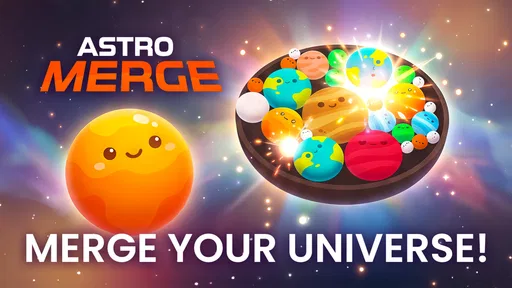
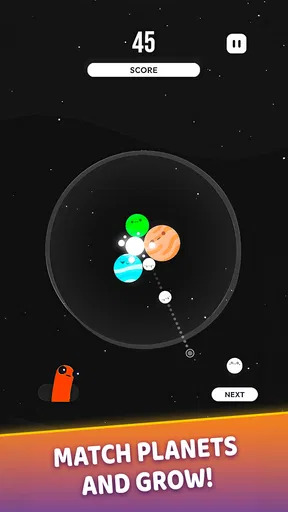
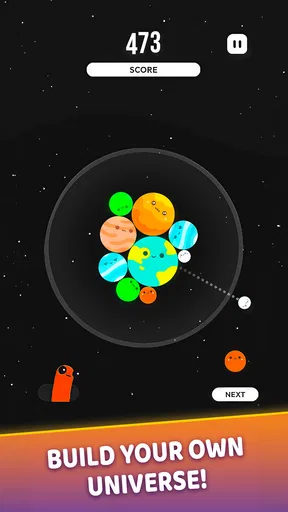
I found Astro Merge most interesting as a small, focused casual game rather than something designed to occupy an entire evening. Its central idea is easy to understand: launch planets, bring matching ones together, and try to build a larger universe while chasing a high score. That simple loop gives it an inviting first impression, especially for players who want a quick game that does not require a long tutorial or a complicated rulebook.
After spending time with it, my view is that its real strength is the way it turns one clear action into a gradual test of planning. You are not only sending objects into play; you are deciding when a match is useful, when the board is becoming awkward, and whether a short-term move will make the next few launches easier or harder. It is free, aimed at Everyone, and developed by Gimica GmbH, so it is positioned as an approachable game for a broad audience rather than a niche strategy title.
How Astro Merge feels to use across different situations
When I think about how Astro Merge fits into everyday play, I focus on how much attention its launch-and-merge loop asks for in different settings. A quiet break gives me room to weigh a placement, while a rushed or distracting moment can make the same decision feel less satisfying. That contrast helps explain why the game suits some short sessions better than others.
Readability and navigation during play
The game’s concept is naturally readable because the goal is visual and direct. Matching planets creates an immediate connection between what I do and what I am trying to achieve. That matters for casual players: I do not have to memorize a large set of menus, character abilities, or mission conditions before I can make a meaningful move.
The short description, “Astro Merge,” is suitably brief, but the actual appeal becomes clearer once the launch-and-merge loop is understood. The universe-building theme gives the activity a recognizable shape, while the high-score element adds a reason to replay instead of treating each session as a one-time puzzle.
I would describe the navigation as best suited to someone who prefers a game that gets to the point. The experience is not built around reading long passages or following a story with lots of dialogue. That can be a benefit for players who find dense interfaces tiring, for younger users who want to start playing quickly, or for anyone opening the game during a short break.
There is also a useful distinction between visual simplicity and guaranteed accessibility. A game can be easy to understand while still asking the player to track several objects at once. In Astro Merge, the important information is tied to the position and identity of the planets, so a player needs to keep watching the play area rather than relying only on text. I found that manageable, but it may become less comfortable for someone who has difficulty distinguishing small, moving, or similarly presented objects.
Worth Reading Before You Choose

Flipboard Shows What News Apps Must Do Beyond the Feed

Switching to Android Auto Means Rethinking Your Driving Routine

Google Calendar Makes a Crowded Week Easier to Manage

Ludo King Makes the Most of the Minutes Between Plans

Baby Panda World Brings Quick Play to Modern Phones, but Its Game Library Feels Busy

ESPN’s Live Game View Makes Following Close Games Easier
My practical suggestion is to begin with a calm session rather than immediately treating the first attempt as a record run. Use those opening moves to learn how much space the planets occupy and how quickly the board can become visually busy. That approach makes the game easier to read because you are learning its rhythm before adding the pressure of chasing a better score.
Motor demands and sensory comfort
The main physical question is whether the player is comfortable making repeated launch decisions. Astro Merge is not the kind of game I would choose for someone looking for a completely hands-off experience. Its core action depends on timing and positioning, even though the overall rules remain casual. Players with limited fine-motor control may find that the difference between an intended launch and an awkward one matters more as the board fills.
That does not make the game unsuitable for every player with motor difficulties. The slower, turn-by-turn nature of deciding where to send a planet can be more approachable than a fast action game that demands constant reactions. Someone who can make deliberate taps or swipes but dislikes rapid sequences may find the pace more comfortable than an arcade alternative.
The trade-off is that a deliberate game can still become demanding when mistakes have a visible effect on the available space. I would recommend using shorter sessions if hand fatigue or concentration fatigue appears. There is little value in pushing through a run when the controls stop feeling precise; the high-score goal is supposed to add replay value, not turn every attempt into a test of endurance.
Sensory comfort is similarly personal. The planets and their movement are the main source of information, so players who are sensitive to motion, bright colors, or a crowded screen should pay attention to how the game feels in practice. I would not assume that a clean concept automatically means a low-stimulation presentation. The safest approach is to try a brief session and stop if the visual activity becomes uncomfortable.
For players who use a phone with one hand, the most useful habit is to keep the device stable before making an important launch. A secure grip reduces accidental movement and makes it easier to concentrate on the placement decision. This is a small adjustment, but in a game where one poor position can affect several later moves, it can make the experience feel noticeably less frustrating.
Playing in ordinary, imperfect conditions
Astro Merge makes the most sense in everyday gaps: waiting for an appointment, taking a short break, or relaxing at home without committing to a long campaign. Its casual format means I can approach it with a simple goal, such as seeing how cleanly I can create a few merges, rather than needing to remember a complex narrative between sessions.
Imagine playing on a bus while standing, with one hand holding a rail and only a little attention available. That is not the ideal situation for a game that asks for careful placement. Even if the rules are easy, an unstable environment can make the physical action less reliable and the visual field harder to follow. In that case, a slower puzzle with fewer consequences for imprecise input may be a better choice.
On a quiet lunch break, the same game fits much better. I can sit down, make a few considered launches, and stop after a run without needing to save a complicated position in my head. The high-score structure also works well for this kind of use because the objective is self-contained. I am competing with my previous performance rather than needing a large amount of uninterrupted time.
It is also suitable for mixed-age households in principle because the content rating is Everyone and the rules are easy to explain. I would still encourage an adult to try it first with a child who has particular visual or motor needs. The broad age rating describes the content, not how comfortable every player will find the interface or physical interaction.
For people who play with sound turned down, the game’s central idea remains understandable because the important relationship is between the planets and the resulting merges. That is a strength of a visually driven design. At the same time, I would not rely on that observation as proof that every cue is available through sight alone. If a player depends on one specific sensory channel, a short personal test is more useful than assuming the game will adapt perfectly.
What the replay loop asks from the player
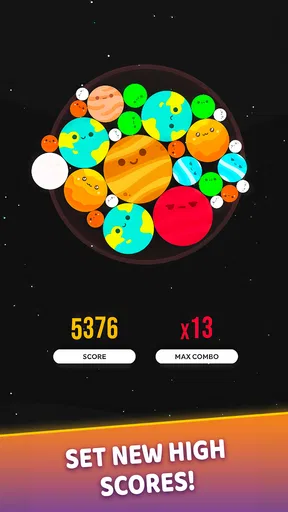
The high-score goal is where Astro Merge moves beyond a basic matching toy. A first session can be about discovering the rhythm, but later sessions become exercises in protecting space and making choices that keep future merges possible. I enjoyed that shift because it gives the simple premise a little more depth without turning it into a heavy strategy game.
One non-obvious lesson is that the most attractive immediate merge is not always the best move. Creating a larger planet may feel rewarding, but the resulting arrangement can leave awkward gaps or reduce the room available for the next launch. I found it more useful to think one or two moves ahead: before merging, check where the new object will sit and whether that position helps or blocks the next likely match.
A second useful habit is to avoid playing every launch as if it were equally urgent. When the board is still open, use that space to create a favorable structure rather than rushing toward the biggest visible combination. This makes the game feel less random because I am shaping the conditions for later merges instead of reacting only to what is immediately in front of me.
A third insight is that a high score is not only a measure of quick decisions. It also reflects how well the player manages visual clutter. If the screen becomes difficult to scan, the problem may not be a lack of skill; it may be that earlier choices created too many competing possibilities. Pausing mentally before a launch and identifying the safest open area can be more valuable than chasing a flashy match.
These ideas give the game a gentle learning curve, but they also reveal its limits. The loop is intentionally narrow. Players who need constant new mechanics, a story, character progression, or a large collection of objectives may find that the same launch-and-merge structure becomes repetitive. Astro Merge is strongest when repetition itself is enjoyable and the satisfaction comes from improving a familiar decision process.
Where it fits beside other casual games
Compared with a traditional match-three game, Astro Merge places more emphasis on positioning and the consequences of each launch. A match-three player may focus on scanning a grid for combinations, while here I need to consider how the planets occupy space and how one action affects the next. That makes it a better fit for someone who likes spatial planning but wants fewer rules than a full puzzle strategy game.
Compared with a fast arcade game, it is less dependent on constant reflexes and more dependent on controlled choices. That may help players who dislike frantic tapping, although it does not remove the need for accurate interaction. Compared with a long progression-based mobile game, it is more immediately accessible but offers less of the feeling of building a persistent account, unlocking a large system, or following an extended journey.
This comparison also clarifies who should skip it. If you want a relaxing game with a simple loop and a personal score to beat, it is a sensible candidate. If you want deep customization, social competition, a rich narrative, or a wide range of modes, I would look elsewhere. The game’s value comes from refinement of one idea, not from trying to cover every kind of mobile entertainment.
Practical details before installing
Astro Merge is free to install, which makes it easy to test without making a financial commitment. It currently appears as version 1.0.0, and it requires Android 7.0 or later. That requirement is worth checking before installation if you are using an older device, particularly one kept as a spare phone for casual games.
The game has passed the early discovery stage with over 50 thousand installs, and its average rating is 4.5 from around 200 ratings. I read that as encouraging interest rather than a guarantee that it will suit everyone. The number of written reviews is much smaller, at roughly a dozen, so I would place more weight on my own first session and on whether the basic interaction feels comfortable.
Those figures also suggest that Astro Merge is still a relatively small casual title rather than an enormous mobile platform. That can be appealing if you prefer a focused experience without the noise of a huge game ecosystem. It also means I would approach it for the quality of its central loop, not because it promises the breadth or long-term infrastructure of the biggest games in the category.
Because the game is rated Everyone, it is a reasonable option to consider for family use, but the rating should not be confused with universal ease of access. A child, older adult, or player with a disability may still need a comfortable posture, a stable device, and enough time to understand the visual relationships. Those practical conditions can matter more than the label when deciding whether it is genuinely enjoyable.
Remaining barriers and who may prefer another game
The clearest barrier is the dependence on visual tracking. If the planets are hard to distinguish, or if movement and crowded arrangements cause discomfort, the central loop may lose its appeal quickly. I would be cautious about recommending it to someone who needs strong text alternatives, audio-led guidance, or extensive control customization unless they have already tested the game on their own device.
Motor precision is another consideration. The game is calmer than a reflex-heavy title, but calm does not mean effortless. A player who has difficulty tapping accurately, holding a phone steady, or making repeated placement decisions may experience more failed moves than the casual label suggests.
There is also a concentration barrier. The rules are simple, yet achieving a good score requires attention to the current arrangement and to the likely consequences of a launch. Someone looking for a game they can play while watching television, walking, or managing another task may find that divided attention produces disappointing runs. A more passive game would be a better companion for those situations.
Finally, repetition itself can become a barrier to enjoyment. Astro Merge offers a compact idea that can be learned quickly, but players who need frequent novelty may feel that they have seen its main appeal after a few sessions. I would not treat that as a flaw in the same way as a broken control; it is a deliberate trade-off. The game chooses a focused loop, and that focus will either feel pleasantly clean or too limited depending on your taste.
My inclusive verdict
I recommend Astro Merge to players who enjoy visual matching, careful placement, and short attempts that gradually become more skillful. I especially see it working for someone who wants a free casual game with a clear objective, a modest learning curve, and enough strategic tension to make another attempt feel worthwhile.
Its inclusive qualities come from its approachable premise, Everyone content rating, and relatively low conceptual load. I can explain the basic idea in a few words, and I do not need to understand a large fictional world before playing. That makes it easier to share with different ages and experience levels.
Still, I would recommend it with a practical qualification: simple rules do not guarantee simple access. The player must be able to follow the planets visually and interact with the launch action with reasonable comfort. Anyone with motion sensitivity, limited precision, or a need for non-visual feedback should test a short session before deciding whether it belongs on their device.
For me, the best way to play is seated, with the phone held securely, and with the first few attempts treated as practice rather than score challenges. That setup gives the spatial decisions room to breathe and makes the game’s small strategic details easier to notice. If that kind of focused, repeatable play sounds appealing, Gimica GmbH has made a promising casual option in its current version.
Overall, Astro Merge is not trying to replace every other mobile game. It offers one compact activity and asks whether I can arrange the next launch better than the last one. I would choose it for a quiet break and a personal high-score challenge, but I would choose a richer puzzle, a more accessible control scheme, or a more varied game when those are the priorities.
Pros
- Simple merge mechanics are easy to learn and play casually.
- Bright space-themed visuals make the game appealing to younger players.
- Short sessions work well for quick entertainment on mobile.
- Progression provides a clear sense of collection and improvement.
- Offline play may be convenient when an internet connection is unavailable.
Cons
- Repeated merging can become monotonous after extended play.
- Some upgrades may require considerable time or repeated actions.
- Ads can interrupt gameplay or appear frequently between activities.
- The interface may feel crowded on smaller phone screens.
- Limited strategic depth may disappoint experienced puzzle players.
FAQs for Astro Merge
What is Astro Merge, and how does the gameplay work?
Astro Merge is a space-themed puzzle game centered on combining matching objects to create more advanced items. During a typical session, you merge pieces on a limited board, plan several moves ahead, and gradually unlock new cosmic elements or rewards. The controls are generally simple, making it approachable for casual players, while efficient combinations and careful board management add more strategy for experienced users.
Is Astro Merge free to download and play?
Astro Merge can generally be downloaded and played without an upfront purchase, although the exact availability may depend on whether you use Android or iOS. As with many free-to-play puzzle games, optional in-app purchases may be offered for boosters, extra moves, cosmetic content, or faster progress. Before downloading, users should review the store listing and payment settings, especially if children may access the device.
Does Astro Merge require an internet connection?
The basic merging gameplay may be playable without a continuous internet connection, which is useful when traveling or when mobile data is unavailable. However, certain functions can depend on online access, including advertisements, cloud synchronization, leaderboards, events, account features, and in-app purchase verification. Offline behavior may also vary after updates, so it is best to test the game before relying on it during a trip.
Is Astro Merge suitable for children and casual players?
Astro Merge is likely to appeal to casual players because its core mechanics are easy to understand and usually do not require fast reflexes. Nevertheless, parents should check the age rating, advertising practices, privacy information, and available purchase options before allowing children to play. Some levels or events may encourage repeated play, and optional purchases can be a concern unless parental controls and password protection are enabled.
What should I check before downloading Astro Merge?
Before installing Astro Merge, check that your Android or iOS device meets the required operating-system version and has enough free storage for the app and future updates. It is also worth reviewing recent user feedback, permissions, privacy details, advertising frequency, and in-app purchase policies. If you care about progress synchronization, confirm whether the game supports an account or cloud backup before changing devices or deleting the app.


